It was one of the most talked-about cases in the latest batch of declassified UAP files: a group of FBI personnel watching a silent, jet-black triangle rise above a mountain ridge somewhere in the western United States, hang motionless in the air, and then vanish into a canyon in the blink of an eye. For many UFO enthusiasts, the credibility of the witnesses alone was enough to put the case near the top of the list. But the man who once ran the Pentagon’s own UFO investigation office is not convinced.

Dr. Sean Kirkpatrick, the founding director of the Pentagon’s All-domain Anomaly Resolution Office (AARO), says the newly released account simply does not contain the kind of evidence needed to determine what the agents actually saw – and he warns that the way the government is releasing these files may be doing more harm than good.
What the FBI agents reported
The sighting took place in June 2026 near an undisclosed national security site in the western U.S. and appears in two separate documents published as part of the Department of War’s rolling release of UAP records, ordered by President Trump earlier this year. One is a signed statement the agents gave to the FBI, the other is an AARO memo summarizing investigators’ debrief with the witnesses.
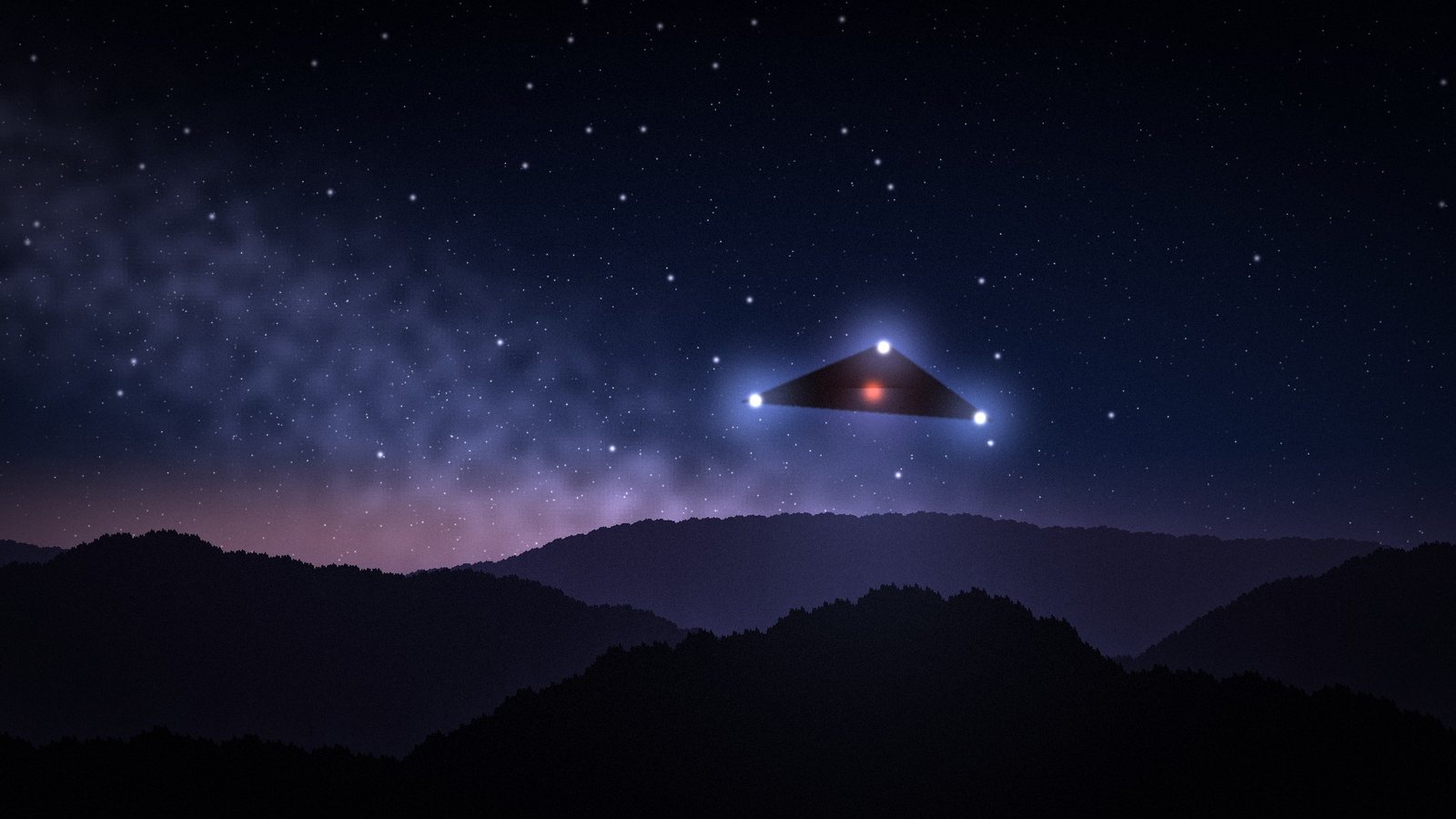
According to those records, the agents were scanning the western horizon when they noticed a large, dark, non-reflective object shaped like a delta-wing drone. Their description includes several details that immediately caught the attention of the UFO community:
- an estimated wingspan of roughly 9 to 15 feet, with a matte-black surface
- no visible engines, rotors, exhaust plume or any other conventional means of propulsion
- complete silence during the entire encounter
- a slow, perfectly vertical climb of about 200 to 300 feet above the ridgeline
- roughly 20 seconds of hovering, followed by almost instantaneous acceleration into a nearby canyon
- a uniform heat signature across the whole airframe when viewed through a handheld thermal scope – with none of the hot spots typically produced by engines
Interestingly, the two documents do not fully agree. The FBI version describes an encounter lasting only a few seconds, while the AARO memo breaks it down into around ten seconds of ascent, twenty seconds of hovering and two to three seconds of high-speed departure. The speed itself was estimated by the witnesses, not measured by any instrument. The Department of War has also confirmed that the images attached to the FBI report are illustrations, not photographs of the object.
“Authority bias” instead of evidence
Speaking to the press this weekend, Kirkpatrick – who spent close to three decades in the Department of Defense and the intelligence community – argued that the professional background of the witnesses does not, by itself, turn a story into data. He described the tendency to accept such testimony at face value as a textbook example of “authority bias.”
Without photographs, radar tracks or sensor recordings, he explained, there is simply nothing for analysts to work with. In his view, many reports boil down to someone seeing something they could not identify, and people then filling that gap with extraordinary explanations that have repeatedly turned out to be wrong.
Kirkpatrick pointed out that triangular craft have a long history of being linked to classified aerospace programs. Before the F-117 Nighthawk stealth fighter was officially acknowledged, for example, its angular silhouette generated a wave of strange-sighting reports. Advanced, still-secret technology therefore remains a serious candidate for at least some modern “black triangle” cases.
Three buckets – and none of them alien
During his tenure, AARO sorted every UAP report into three broad possibilities: advanced technology operated by a foreign adversary, ordinary objects or sensor artifacts that were misidentified, or something genuinely extraterrestrial. Each category has its own characteristic signatures, and investigators compare the real data from a sighting against those signatures.
According to Kirkpatrick, nothing his team reviewed ever matched the alien hypothesis. The vast majority of cases turned out to be mundane objects that military sensors were never designed to recognize, while a small number showed signs of possible foreign involvement and were passed on to national security officials.
He also stressed the difference between two words that are often used as if they meant the same thing. An unidentified object is one that can be observed and characterized with data, even if its exact nature is not yet known – like the objects shot down over North America in 2023 after the Chinese spy balloon incident, which were later determined to be balloons. An unresolved case, on the other hand, usually means there is not enough data to reach any conclusion at all.
Explosive claim: solved cases released as “unresolved”
The most striking part of Kirkpatrick’s comments concerns the release process itself. He claims that some of the cases now being published as unresolved had in fact already been resolved by AARO – and that he had even briefed Congress on several of them, including the likely explanations.
According to the former director, Pentagon leadership instructed AARO to strip the resolution language from those files before they were made public, in order to let the public decide for themselves. Kirkpatrick called that approach the worst possible choice, arguing that it only adds fuel to conspiracy theories. He did not say when the instruction was given or which officials were behind it.
The Department of War, for its part, says it is deliberately not offering any assessment of the released material – neither of the collection as a whole nor of individual files – so that Americans can reach their own conclusions. The Pentagon has not publicly confirmed Kirkpatrick’s allegation.
Part of a much larger disclosure push
The black triangle report arrived as part of the seventh release under the presidential UAP disclosure order, which in this tranche alone included 28 PDF documents. Since the official WAR.GOV/UFO portal launched on May 8, 2026, it has reportedly been visited more than a billion times, and the files now span roughly eight decades of reports – from 1950s sightings around California’s Santa Catalina Island and a 1957 radar contact logged by a B-52 bomber, to recent accounts of orange orbs releasing smaller red orbs near a sensitive U.S. facility.
Kirkpatrick believes many of the historical cases must be viewed in the context of the technology of their time, such as early high-altitude balloon programs. He also notes that the sheer volume of reports works against the extraterrestrial explanation: even if alien visitation were real, it would hardly produce thousands of separate encounters. While he considers it statistically almost certain that intelligent life exists somewhere in the universe, he regards the idea that it is visiting Earth as equally improbable.
His overall verdict on the newest files is blunt: in his opinion, they contain nothing new.
What does it mean for the black triangle mystery?
For skeptics, Kirkpatrick’s comments confirm that eyewitness testimony – no matter how credible the people involved – cannot replace hard data. For those who believe the government is still hiding the truth, his claim that solved cases were deliberately repackaged as mysteries raises a very different question: if the Pentagon is editing what the public sees, what else might be missing from the files?
One thing is certain: the image of a silent black triangle rising over a dark ridgeline will remain one of the most discussed UFO stories of 2026 – at least until the next batch of files is released.
Leave a Reply