3I/Atlas: The Mysterious Interstellar Visitor Stirring Scientific Debate
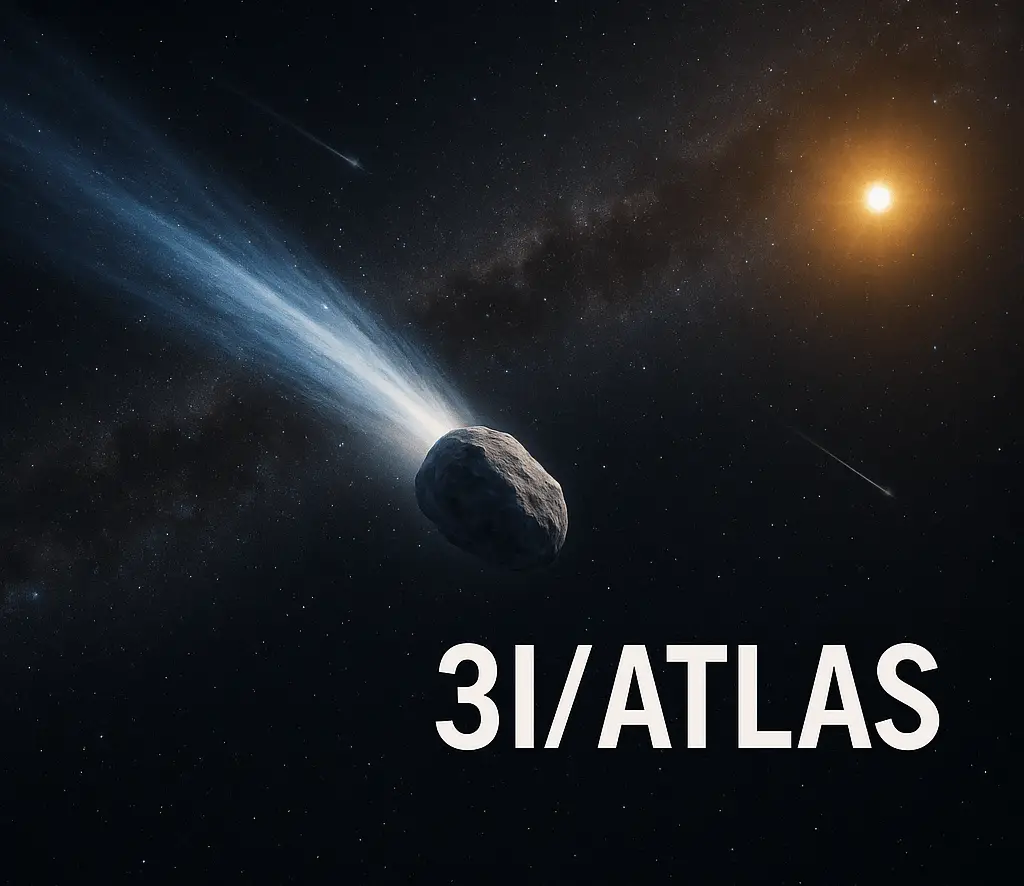
When the faint glow of a fast-moving object appeared in telescopic images earlier this year, astronomers realized they were witnessing something extraordinary — an interstellar visitor entering our solar system for only the third time in recorded history. Designated 3I/Atlas, this enigmatic body has reignited debate about the origins of such cosmic travelers and whether any might be more than just natural debris.

A New Interstellar Arrival
Before 3I/Atlas, only two interstellar objects had been confirmed: 1I/‘Oumuamua in 2017 and 2I/Borisov in 2019. Unlike ordinary comets from the distant Oort Cloud, interstellar bodies arrive on hyperbolic orbits — their speeds too high for the Sun’s gravity to capture.
3I/Atlas entered the solar system at roughly 130,000 miles per hour (210,000 km/h), a velocity that immediately marked it as an outsider. Its discovery excited astronomers and observers alike, not only for what it might teach us about other star systems, but also for its peculiar behavior and composition.
Avi Loeb’s Controversial Hypothesis
Harvard astrophysicist Professor Avi Loeb, known for proposing that ‘Oumuamua might have been alien technology, once again drew public attention by suggesting that 3I/Atlas could also be of artificial origin.
Loeb urged NASA to release high-resolution images reportedly taken by the Mars Reconnaissance Orbiter and the James Webb Space Telescope, arguing that the data could clarify whether the object is natural or something more remarkable.
He has rated the possibility of alien technology at 4 out of 10 — not a firm claim, but enough to call for scientific transparency:
“The politics of the day should not sabotage science. They have the data. They should share it with scientists,” Loeb said in an interview.
The MUFON Panel: A Scientific Counterpoint
A detailed discussion hosted by MUFON (Mutual UFO Network) brought together astronomer Mark D’Antonio and astrophotographer Greg Cisco, who both argued that 3I/Atlas appears to be a comet, not a spacecraft.
Their reasoning rests on several observational facts:
- No artificial structure has been detected — only a bright, diffuse coma typical of comets.
- No measurable acceleration (the “rocket effect” seen in active comets) has yet been confirmed.
- The object’s chemical composition includes carbon monoxide, carbon dioxide, cyanogen, and nickel — elements common in cometary materials, though in unusual ratios.
- An apparent “forward-pointing tail” is explained by a known optical effect called an anti-tail, caused by the geometry of the Earth, comet, and Sun.
Cisco noted that anti-tails have been recorded many times before and are purely a matter of perspective. D’Antonio added that the presence of nickel without iron, while unusual, does not necessarily imply a technological source — only that this comet formed under different conditions than most known comets.
What Makes 3I/Atlas Unique
Despite skepticism toward alien theories, 3I/Atlas remains scientifically fascinating. Its path through the solar system is highly unusual — entering almost parallel to the planetary plane, an orientation estimated to occur by chance only once in 200,000 events (0.0005% probability).
This rare geometry means the object’s approach offers astronomers a chance to study interstellar materials under different light and gravitational conditions.
Moreover, its chemical profile stands out: higher concentrations of carbon dioxide and nickel than seen in most comets suggest it formed in a colder or metal-richer environment, possibly in the outer regions of another star system.
Debunking the Myths
As 3I/Atlas gained attention, social media filled with sensational claims — that it was accelerating faster than light, that it had six headlights, or that it was a cylindrical mothership photographed near Mars.
Experts swiftly debunked these stories. The “cylinder” image, for example, was simply a time-exposure streak captured by the Perseverance Rover’s camera, not a solid object. And no object with mass can move at the speed of light without turning into pure energy — a basic consequence of Einstein’s relativity.
The Call for Open Data
Professor Loeb’s insistence on releasing all available imagery reflects a broader tension in modern science: public access versus institutional control. Loeb argues that withholding high-resolution data prevents independent researchers from performing peer review and slows discovery.
Whether or not NASA is truly delaying data for political reasons, his call highlights the importance of transparency in astronomical research, especially for events that stir global curiosity.
Expert Consensus: Probably a Natural Visitor
After extensive analysis, both D’Antonio and Cisco concluded that 3I/Atlas behaves like a natural comet. Its brightness, tail structure, and lack of obvious propulsion or structure point to natural origins. They each rated the probability of an alien spacecraft as 1 out of 10, compared with Loeb’s more generous 4.
Their conclusion echoes the cautious approach of mainstream astronomy: intriguing anomalies don’t automatically imply extraterrestrial technology.
Why 3I/Atlas Still Matters
Even if it proves entirely natural, 3I/Atlas provides a window into the chemistry of other solar systems. By studying its dust and gas emissions, astronomers can infer how distant planetary systems evolve, what materials form their planets, and how often solid bodies are ejected into interstellar space.
Objects like ‘Oumuamua, Borisov, and Atlas may be the first of many interstellar visitors we’ll encounter as survey technology improves. Each one carries clues about the wider galaxy — perhaps even precursors to future discoveries of genuine alien artifacts.
Conclusion
3I/Atlas reminds us that science often thrives in the space between mystery and evidence. While Avi Loeb’s provocative theories keep public imagination alive, the data so far paints a more grounded picture: a rare, unusually bright interstellar comet gliding past our Sun before disappearing into the void once again.
Whether natural or not, 3I/Atlas challenges us to look deeper, question boldly, and share knowledge openly — the true spirit of exploration that drives humanity’s search for understanding in the cosmos.
NASA = “never a straight answer”