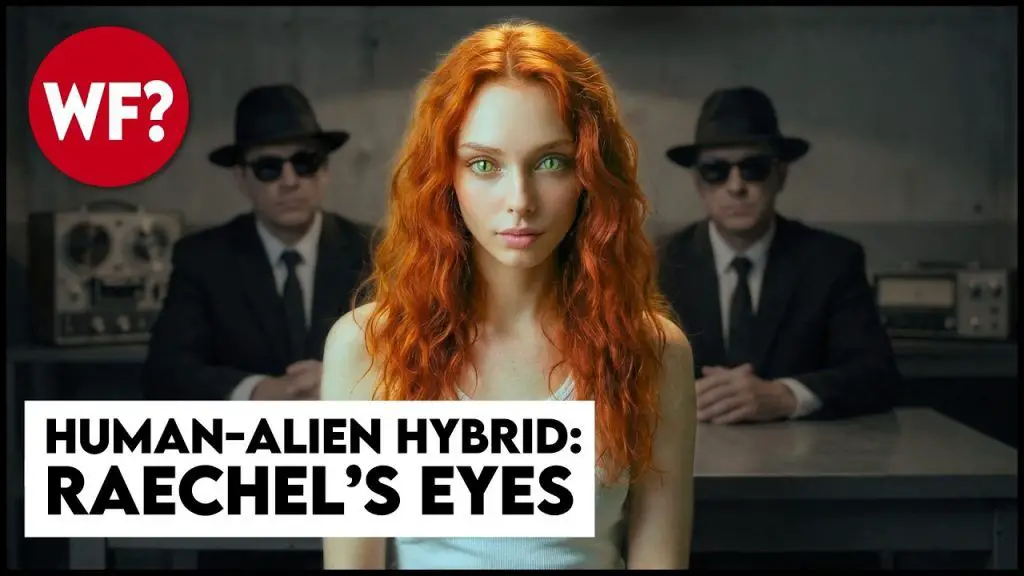
In the quiet suburbs of Sacramento in the early 1970s, a blind college student named Marissa Latrell was desperate for a roommate.
Her counselor arranged what seemed like the perfect match — a polite young woman named Rachel who spoke like a robot, wore sunglasses indoors, and seemed completely unfamiliar with the world around her.
But when Marissa’s mother, Helen, came to visit, everything changed.
As Helen reached out to steady the girl, Rachel’s skin felt cold, spongy — like raw mushrooms.
Her sunglasses slipped, revealing large green eyes with vertical pupils, the eyes of something not entirely human.
And then, in an instant, Helen felt thoughts that weren’t her own flood into her mind.
Rachel wasn’t human.
And the U.S. Air Force officer who arranged for her to live there knew it.
A Classified Experiment Called “Project Humanization”
The story began long before that day in 1972.
In 1951, Helen claimed she was taken against her will — paralyzed under a bright blue light — and impregnated by something she could barely comprehend.
The being told her: “It will look like you, but it will be like us.”
Years later, that “child” returned to Earth.
Colonel Harry Nadian, an Air Force officer stationed at a secret base in Nevada, had been involved in a clandestine operation known as Project Humanization — an attempt to blend extraterrestrial DNA with human genetics to save a dying alien species.
The beings, known as the “Grays,” had lost their ability to reproduce naturally. They needed us — humanity — to survive.
After one of their craft crashed in the desert, Nadian discovered a young female survivor — part human, part alien. He adopted her, named her Rachel, and began raising her as his daughter. She was the first of her kind — a fully functional hybrid designed to live among humans.
The Experiment
Rachel spent years being trained to appear human — her speech, behavior, and even diet were monitored.
She wore hats and glasses to conceal her features, and ate only a mysterious green nutrient paste marked with a red triangle, the symbol of the program.
When she was finally ready, she was placed in the outside world — as a college student, with a blind roommate who wouldn’t notice her differences.
That roommate was Helen’s daughter, Marissa.
What the Colonel didn’t realize was that both women — Helen and Marissa — were already connected to Rachel by blood.
Helen was Rachel’s biological mother.
Marissa was her half-sister.
The entire roommate arrangement wasn’t luck — it was planned.
The military wanted to see what would happen when a hybrid interacted with her own human family.
A Hybrid’s Humanity
Over time, Rachel became more than a subject — she became human in the truest sense.
She laughed, learned, cared, and even healed her sister’s blindness before disappearing for good.
That act of compassion — choosing love over obedience — was her final betrayal of the program that created her.
Soon after, Rachel died under mysterious circumstances.
Officially, she fell down a flight of stairs.
Unofficially, she was “liquidated” — erased to protect a secret that could unravel everything.
The Evidence and the Mystery
Helen Latrell documented her story in the book “Rachel’s Eyes.”
Skeptics dismiss it as the product of false memories induced by hypnosis decades later.
Supporters note that her descriptions remained consistent over time, and that she risked ridicule and threats to tell the truth.
Records from American River Junior College once confirmed Rachel’s enrollment — until the document vanished, and the employee who signed it was transferred.
Rachel Nadian was erased from history.
The Tragic Irony
Whether fact or fiction, Rachel’s Eyes speaks to something profoundly human — the desire to belong, to be loved, and to understand where we come from.
Rachel, a being born of two worlds, achieved what her creators couldn’t:
She felt empathy, compassion, and love.
In the end, that was what made her too human for the project — and what cost her life.
The Legacy
For believers, Project Humanization is proof that humanity is part of a larger cosmic story — one in which our DNA is both experiment and key.
For skeptics, it’s a modern myth born from trauma and imagination.
But either way, the question lingers in the dark corners of classified archives and desert skies:
What if some of us really don’t come entirely from here?
Ufo
An opportunity to communicate with a visitor from another World is something I have always dreamed about, as long as my immediate family is or was not I injured in any way. I have had dreams that included female officers from their interplanetary craft who were fascinated with male specimens from Planet Earth.
Ironically, the visitor I spoke with had a lot to say, but unforseen distractions, including, intoxicating beauty, combined with hypnotic aromas and flavors. The eyes were a magical portal that led or will lead the candidate to a place of wonderment and complete satisfaction of glutaneous flavors and olefactory fantasies.
Why would I or should I call or report my reality voyages to anyone? The eyes were a soft powder green, her name is, Dusula Ixmeager.